
Mount Zion Black Cultural Center
To Be Done Studio
CULTURAL / ADAPTIVE REUSE / COMMUNITY
PROJECT OVERVIEW
Preserving Legacy, Activating Story
The Mount Zion Black Cultural Center reimagines the historic Mount Zion Baptist Church in Athens, Ohio as a living cultural hub—preserving its legacy while transforming it into a space for storytelling, education, and community engagement.
Originally built by free-born and formerly enslaved Black artisans, the church served as a vital anchor for the Black community in Appalachia—a place of gathering, resilience, and spiritual connection. Today, through a collaboration with the Mt. Zion Baptist Church Preservation Society, the project revitalizes this landmark through preservation, rehabilitation, and adaptive reuse.
Guided by the 2020 Citizens’ Institute on Rural Design (CIRD) framework, To Be Done Studio transforms the building into a dynamic environment where oral histories, cultural narratives, and community memory are actively experienced and shared.
Where history is preserved. Where stories continue.
THE ARCHITECTURAL PROJECT
Designing for Storytelling, Memory, and Community Use
The design of the Mount Zion Black Cultural Center centers on adaptive reuse—preserving the architectural integrity of the historic church while introducing flexible systems that support evolving narratives and community programming.
The space is organized around three distinct modes of engagement:
Immersive Interactive Mode — a theatrical experience using film projection, lighting, and performance to bring stories to life
Passive Exploratory Mode — a meandering multimedia exhibit allowing visitors to move through layered histories at their own pace
Archivist Guide Mode — a reflective experience highlighting the building’s physical traces, or “thumbprints,” revealing its lived history
A key feature of the design is a flexible scrim system, which enables projected storytelling within the sanctuary. This system transforms the interior into a dynamic narrative environment—shifting atmospheres and spatial perception to deepen emotional engagement.
The architecture balances preservation and innovation—ensuring the building remains a tangible record of its past while supporting its future as a cultural and educational resource.
Architecture as a storyteller—preserving the past while activating the present.
ARTIST INTERPRETATION
Echoes in Stone
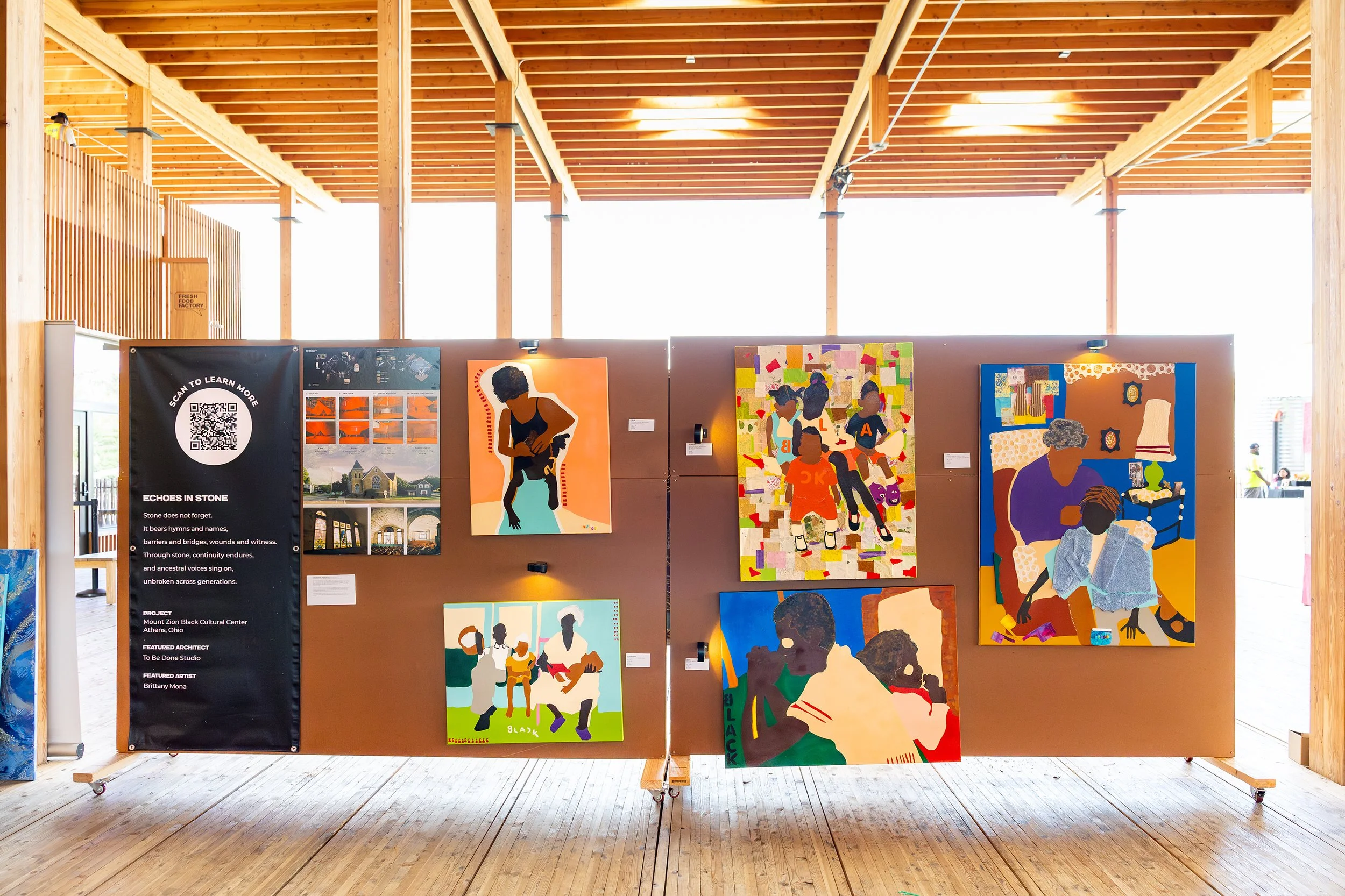
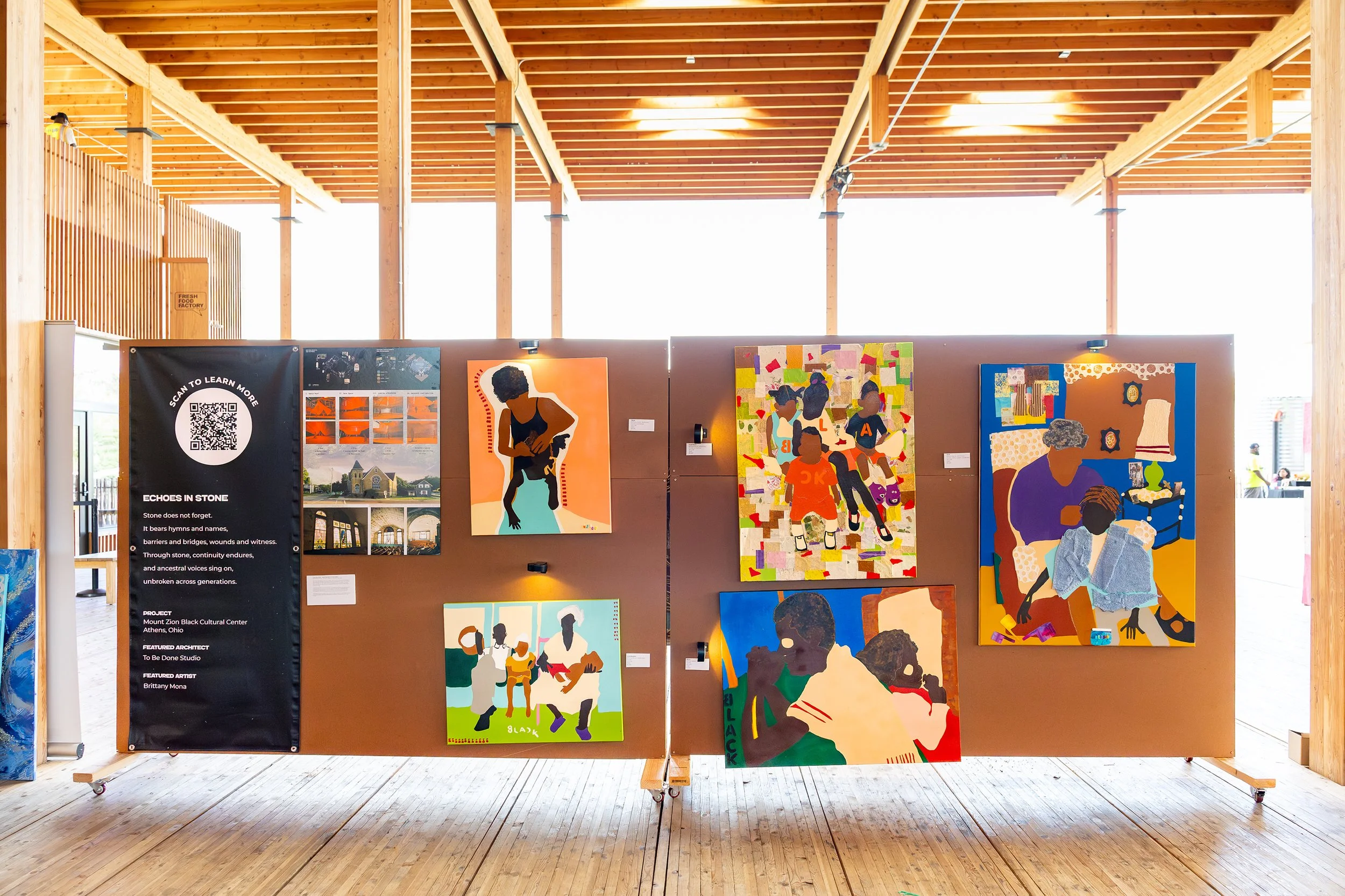
“Echoes in Stone” reflects the quiet, enduring presence of memory within community, family, and place. Brittany Mona’s work centers on simplified, faceless figures—allowing identity to extend beyond the individual and into shared experience.
Through flattened forms, layered compositions, and muted yet intentional color palettes, the artwork captures intimate moments of care, connection, and generational continuity. Scenes of families, children, and elders are not fixed narratives, but fragments—suggesting memories that are felt rather than explicitly told.
The absence of facial detail becomes a powerful device, inviting viewers to see themselves within the figures and to recognize the universality of these relationships. These moments echo the history embedded within the Mount Zion space—stories carried through people, not just preserved in structure.
Positioned alongside the architectural narrative, the work reinforces the idea that history lives not only in buildings, but in the lives, interactions, and memories of those who inhabit them.
Hold the memory.
Feel the presence.
Carry it forward.
THE COLLABORATION
Where Architecture and Art Intersect
The collaboration between To Be Done Studio and artist Brittany Mona transforms the Mount Zion Black Cultural Center into a deeply human, story-driven environment. Architecture provides the framework for preserving and presenting history, while the artwork brings forward the lived experiences that give that history meaning.
Architectural drawings and research materials ground the installation in the physical and historical reality of the church, while Mona’s figurative compositions introduce intimacy—highlighting family, care, and generational connection.
Together, they create a layered narrative: one that moves between space and story, structure and memory. The installation reflects the project’s central idea—that history is not static, but continually shaped by those who remember, share, and carry it forward.
A shared vision—where memory becomes space, and space becomes story.
Mount Zion Black Cultural Center
PROJECT DETAILS
Adaptive Reuse / Cultural / Community Space
FIRM
To Be Done Studio
ARTISTS
Brittany Mona

THEME
Memory, Truth & Reckoning
YEAR
2025